Game Design

Scrap Pirates – GGC-results, kind of

So, GGC is over. No prize, but Scrap Pirates were nominated over half of the categorize we could be nominated for. Nominated meaning we were in the top five.

Even if we did not win anything we are still content with the conference and we think we will continue working on it again after the summer and a well needed vacation.

Have a good summer, everyone!

Standard
Game Design

Scrap Pirates: In the middle of GGC

So, we are in the middle of GGC, Gotland Game Conference. Well, maybe not in the middle, more like the two thirds through, only one more day out of three. We are showing of Scrap Pirates and a lot of people seem to like it. Tomorrow is the last day, which means that the deadline for voting and the following award ceremony will be held. I would be really happy if we were to win some award for Scrap Pirates because we have all worked so hard to make it as good as we could during this limited time that we had. But even if we don’t I will not feel let down or anything, there is a lot of hard competition this year and a lot of games deserves awards. It is so hard to say which game will win what award and I am sure that it will be a close run in all categories in this year’s GGC.

I will give you all an update on how it went when it is all over 🙂

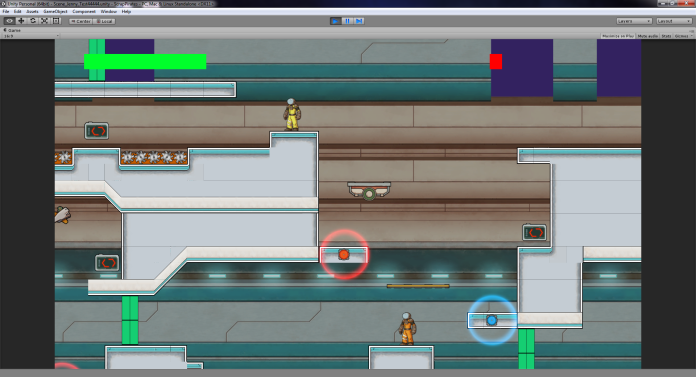
The two players and one of our enemies, the Caterpillar, in its defensive stance.

The two players and one of our enemies, the Caterpillar, in its defensive stance.

Standard
Game Design, Programming

Week 7: Scrap Pirates, one week left before GGC!

Hello! Week 7 has just passed and Gotland Game Conference is in just one week. A couple of weeks back we decided to cut back on a couple of features like upgrade system, some enemies, multiple levels, among other things, and I feel like that was a good decision because otherwise we would be up to our necks in half-done things and nothing would probably feel finished for GGC.

As I mentioned the last time I had one bigger problem to try and solve, it was the parallaxing windows into other rooms. After a lot of testing with placeholder graphics and a lot of discussions we have decided to put those parallexes on hold until after GGC because of two reasons: first, the graphical artists are already up to their necks with stuff to get done before the conference, and secondly because it does not feel good with our placeholder graphics. I think that the programming part of the parallexes is done, only variable changes so they scroll the right speed, but it is hard to test without the right textures to test with. Anyway, as I said, we have put those windows on ice and will just keep us to scrolling space parallexes instead.

So, what do I have left to do this week? I will need to make a couple of different TriggerZones for different actions. One of them will be that when a player enters it, it will light the lamps in the room and remove the shadowsprite over time. Another zone will be that when both players have entered it, it will close the doors behind. I do not foresee any difficulty in making those two scripts. I will also implement a highscore list so that those that come and test our game at GGC can compete with each other trying to get as high as possible. I have not done a save system before, but I do not think it will be so hard, should be plenty of guides out there.

Other than that, I only think it is bug-fixes and polishing left for my part.

I hope I will see you guys at GGC this year! (Free entrance for the public on Monday and Tuesday!)

Standard
Game Design, Programming

Scrap Pirates – Ranting about Physics

I think it is time for a status update on what I am working on.


I have had two bigger problems thus far in this project. The first one is about our physic. It was apparent early that Unity’s own 2D physic did not work so well for us. Because of how we want the magnetism to work and that things in the environment should be able to knock you around a bit, we could not just set the players and the objects velocity directly. So instead we tried to add a force instead, but the problem with that approach was that it felt that the player was gliding around on ice; it took a while before the character came to a stop. Neither of those approaches seemed to work so well for us.

I tried to change the physics material on the players and on the ground, changing its friction to try and work it out. If I had low friction the “ice-skating” was horrible. If I turned it up it felt sluggish to get momentum, it took too long before the character got up to its maximum speed.

When I could not get it to work with the Unity’s own physics I decided to try to write my own simple physics. After some trial and error I thought I had gotten in as we wanted it. There was almost no more sluggishness or slipping around.

Now, the only problem was the boxes the players could throw around were behaving very strange if thrown into the air. They lost all their momentum on the x-axis after just half a second even if it took it more than a second to get back to the ground. This meant that if anyone threw a box in a 45 degrees angle it would, almost instantaneous move to a much steeper angle and going almost straight up before losing y-axis momentum and coming straight down again.

To do this I made a couple of exceptions in the physics. Instead of treating everything the same, no matter what was happening I changed so that if something did not touch anything else, it would not lose any x-momentum. This gave the box-throwing a much nicer arc while still making sure that they came to a quick stop when they touch ground.

Another exception I had to do, in response to the exception above was to only apply that exception on the object if it was not a player. Otherwise the player would have a hard time controlling its character in air, and that would make it very frustrating for the player because we want the player to have much control while in the air.


Alpha version of Scrap Pirates, some placeholders still there, most notably the doors and the healthbars

Alpha version of Scrap Pirates. Some placeholders still there, most notably the doors and the healthbars


The second big problem I have had is something else entirely. It has to do with “parallaxing” the content of windows on the ship. It is very frustrating and hopefully I will find a solution soon, or else we will have to go with something easier.

The window problem has to do with that we want to give a depth to a room seen through one of the ships indoor windows by having multiple parallaxes. For example: We want a window where the back wall is slowly scrolling, then a couple of pipes scrolling in another speed and yet another layer with more pipes or something else, everything scrolling when the camera moves and at different speeds. I have tried to only scroll the Texture and not having to use multiple Quads, but so far I have not been able to make it look good. Hopefully I will come up with a solution soon; otherwise we will have to rethink if we can do it without having multiple layers of parallaxes.


Bye. It is back to work for me now.

Standard
Game Design

Big Game Project: Scrap Pirates. Week 1-3

Hellooo…

It has been almost half a year since my last post but now it is time to start posting again and a new course begun three weeks ago, Big Game Project. It is just as it sounds, we are to create a game during this course and eventually show it off at Gotland Game Conference in late May this year.

The joined the group Sprocket with the game Scrap Pirates. Scrap Pirates is a Metroidvania style exploration/platformer with a focus on two player co-op puzzle gameplay. The goal of the game is to progress through levels by solving puzzles and picking up scraps. The aid the players solving the puzzles they can activate a magnetic field around their avatar which will allow them to move crates too heavy to move otherwise. I am one of only two programmers in the group, together with three graphical artists and two level designers.

The two first weeks were mostly preproduction: planning, designing and so on. But now we are in full production mode. The first deadline is in a week, the next Friday, and then, the Wednesday in about two weeks, it is the Alpha deadline. I am pretty certain we will have a working Alpha version of the game before the playtesting next week. The big things left to implement for my part before that are animations and re-spawn; everything else is working decent enough for an alpha version at least.

If I remember correctly, the only big feature left for us programmers to implement after that is an upgrade system which will allow the players to upgrade their toons by spending the scraps they have collected so far. I have probably forgotten some feature while writing this, but that is probably ok anyway…

The pictures demonstrate a very early prototype of the players together with our first enemy, the Welding Arm.WelderArmEnemy1

Standard
Programming

Game Programming 3 week 1

So, a new course has begun. Game Programming 3. This course focuses on 3D programming, with some networking too. This first week was about templates, linked lists and binary search trees.

Templates were something I had not worked with before and I must say that I start to like them. Instead of having to create a new function for each of type of parameters (int, float, double, etc) it should be able to take, I could just make a template function. The compiler takes care of the rest, creating multiple functions from that one template. The drawback with this is that the time it takes to compile the code can increase drastically.

We also got an assignment in three parts to do before this course is over. Part one is to create a linked list and a binary search tree. Part two is to create a web server using bsd sockets Application Protocol Interface (API) and Transmission Control Protocol (TCP). Finally, we are to create a 3D game. Part one and two are individual work while part three is to be done either alone or in a small group of up to three persons.

So, this week I have begun on the first part. The linked list is done and the work with the binary search tree is about halfway done and I will finish it this weekend.

How does the linked list work, or rather, a double linked list? It consists of nodes. Each node holds data together with two pointers, one pointing to the next node in the list, and the other pointing to the previous one. This means that if one node would be lost, the list after that node would also be lost. It also means that the list can grow and shrink without moving the entire list. All that is needed to insert a node in the middle is to redirect the next pointer of the one before, and the previous pointer of the next one. Instead of them pointing at each other they will instead point to the new node and the new nodes pointers pointing at the old ones. So, the only thing the list has to know is where the list begins and from there it can access the other nodes by going through nodes, one by one.

The binary search tree is similar to a linked list with nodes and pointers. The difference is that instead of one pointer to the next node, it has two, one pointing to a higher value node and the other pointing to a lower value node. So, to find the node you are searching for you start at the beginning of the tree, the node that was added first. You check to see if it is the value you are looking for. If it is the right one, you are done with the search and you now know that it exists. If it was not the right one, you check to see if the value you are searching for it higher or lower than that node and follow the right pointer to the next node where you repeat the same process until you find the node you are searching for, or ends up at a null pointer, a pointer that does not points to another node. In that case you know that the value you are searching for does not exist in this tree.

Next week we will start with network programming and the second part of the assignment.

Standard
Game Design

Board Game Analysis 2

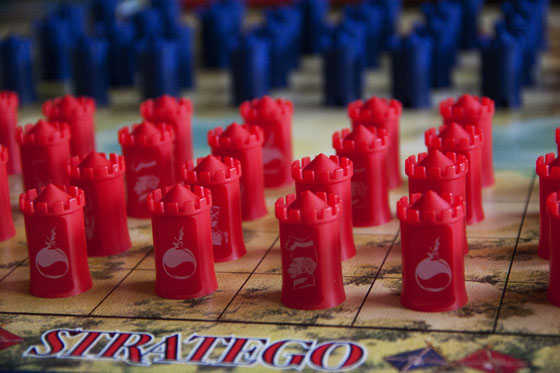
This week we picked another board game to play and analyze. We chose Classic Stratego, I am not exactly sure which edition it was, but I think it was one from 1999 because the rulebook were copyrighted that year.

Stratego


Game Overview

Stratego is a two player turn based strategy game where the objective is to capture the enemy flag. The board is divided into a 10×10 grid. The game has two phases, the first is the “setup phase” and the second is the “play phase”.

During the Setup phase a screen is placed at the middle two rows so the players cannot see the opponent’s side of the board. Each player put their pieces on their side of the board with the image on the piece facing them so that the opponent cannot see which unit is where when the screen is removed.

When all units have been placed on both sides the screen is removed and it is red’s turn to start. The players’ takes turn moving or attacking one unit at a time.

Each unit that can attack have a number associated with it, this is its strength. The units are:

1 – Spy – The spy is the weakest unit. It can only defeat the enemy Marshal (10), and then only if it is the spy attacking.

2 – Scout – The scouts can move any distance in one direction as it wish, as long as there is nothing in its way. It can also attack if there is an enemy at the end of that line.

3 – Miner (Sapper) – The miners are the only unit that can remove the bombs from the play field.

4 – Sergeant

5 – Lieutenant

6 – Captain

7 – Major

8 – Colonel

9 – General

10 – Marshal

Bomb – Cannot attack or move, but defeats all units attacking it, with the exception of the miner. It can only be removed by an enemy miner attacking it.

Flag – Cannot move or attack. The ones whose flag were captured by the enemy lose the game.

If one player tries to move a unit onto a tile that is already occupied by an enemy unit the moving unit is attacking. Both players reveal the units. The unit with the highest strength wins the battle and the other is removed from play. If both reveal the same strength they are both lost and removed. The game is won by either capturing the enemy flag or by defeating all enemy units that can move, whichever comes first.


The Best Sides of Stratego

What I like about Stratego is that you can never be sure about anything until there is a skirmish. With that I mean that unless there is a battle you can never know which enemy unit it is. The exception to this being if the enemy moves a piece more than one square in one goes, and then you know it is a scout. This makes you being on the edge every time you attack an unknown piece or if one attacks you.

Another thing is the amount of different ways, or strategies, you can have when placing your board. Where do you place your flag? In one of the corners or out on the field? Surrounded by bombs or alone? Each strategy has its strengths and weaknesses.


The Worst Sides of Stratego

This one is hard. I have not found anything I really dislike about Stratego. It wouldprobably be that if you play against the same player over and over again you will find out that he or she probably prefers a certain play style, for example how she places the flag and bombs, if it is an aggressive player of a defensive. But this does not really have anything to do with the actual game, so I probably should not take it up here under “The Worst”.

The only thing that they should have clarified more in the rules is if a bomb is removed or remains in play after it had been triggered. That is the only unclear thing I can find in the rules.


Stratego

Our Experience

It was an easy game to learn. It is not so many rules and things were logical, for the exception of the bombs staying in play even after they had exploded. No were in the rules does it say if the bombs are removed or stays after a battle. The only thing it says is that if a Miner (3) attacks it, it is removed. We had to look it up on the internet were we found out that it remains until a Miner takes it out.

The first game we played took about 90 minutes to play. Both players played somewhat defensive and tried not to lose any units if possible. It were a lot of “cat and mouse” where one would chase the other unit, and then turn around when another, stronger unit came close, making the other player the chaser. Towards the end each player had about ten to fifteen units left when a Miner made its way to the other players wall of Bombs, disarmed one and captured the Flag behind, bringing the game to an end.

The second game was a lot faster. This one I played. I had placed my Flag in a corner, protected with two Bombs in either direction the opponent could come from. The rest of my units I had spread out evenly around the board with the Marshal (10) and the Spy (1) in the middle so they quickly could respond to the enemy Marshal if needed. What I did not expect was that my opponent would go full out attack, on the same side as my Flag. I did not have time or space to get my Marshal there in time. He broke through my defenses, bought with him a Miner (3), disarmed the Bomb and captured my Flag. The game took about 20 minutes, including the Setup.

There were several elements of both luck and skill involved in my opponent’s victory over me. Firstly, he was lucky that he chose to attack on the same side as my flag, because if he had chosen to attack on the other side or if I had placed my Flag there he would have had a much harder time winning because I had assassinated his Marshal with my Spy a couple of turns before. Another thing that I found out right after he had taken my Flag was that right next to my spy was his Flag, undefended. All I had to do was moving my Spy one step to the left and take it. He had placed his Marshal right next to it as its only defense, relying on that his offensive would take occupy me enough so that I would not have time to strike at him.

The third game it was my turn to be lucky. This time I faced one of the two that played the first game. This time I chose to have my flag in back row closer to the middle, defended by three bombs, one on either side. The match started and started attacking him in the middle and to the right. I sent in one unit at a time, Captains (6) and Lieutenants (5) mostly, penetrating deep into his territory before they came upon a bomb or a higher ranked unit. While I did this he attacked on the left and started killing of my stronger units. Suddenly, the game ended, one of my Captains (6) (I think it was) had captured the Flag. So, only by luck I had found and captured the Flag and ended the game after only 15 minutes. I did not expect that because his play style was one that makes for long games.

Our last game was played by the two that played the first match. This one took about one hour I think and played out mostly as the first one did with lots of thinking and moving forth and back, but also a lot of deceit. One player attacked with his Marshal (10) and the only 2 units that can take out the Marshal except the Bomb is the other Marshal and the Spy (1). So when the opponent started moving another unit, from pretty far away towards the Marshal, the Marshal player thought it had to be the Spy so retreated with him, only to find out, a bit later when he could take it, that it was in fact a Sergeant (4). And now the really interesting things started. Both tried to fake the other player into believing that the unknown units were something else. For example only moving the Scouts (2) one tile at a time until it was lined up so it could make a straight move and attack what he thought was the enemy Spy, only to find out that it was not a Spy, but something else. Eventually one player got a Miner (3) behind enemy lines and succeeded in capturing the Flag.


Target Audience for Stratego

The box says “From eight years and up” and I think that could work fine. It is not many rules to keep in mind but I would guess that a game between two eight years old would be pretty straight forward – full out attack. To get the full experience of Stratego I would suggest the players to be at least eleven or twelve years.

I think it is a great game for everyone that enjoys a good time with a friend or family member. It works well for old as well as for young.

stratego2


Well, that’s it for me this time. We will see if it will be another board game that I will analyze next or if it will be a roleplaying game. The instructions are pretty confusing at the moment, with teachers saying one thing and the course side another 🙂

Standard
Game Design

Board Game Analysis 1

So, long time since last. This time I am not going to write about programming or any digital game. We got a group assignment where we were to pick a board game, play it, and then write an analysis about it.

So, we picked Carcassonne with River expansion. It is a turn based strategy game for two to five players. The players take turn drawing tiles, placing them and followers in order to score as much points as possible by the games end, which is when the last tile have been placed.
200px-Carcassonne-meeple

There are a couple of features that can exist on each tile:

  • Field
  • Road
  • City
  • Cloister
  • River (only with the river expansion)

The rules for placing tiles are that the player has to place the new tile side to side with an already existing tile. Each tile has four sides which each have a feature. The tiles can only be placed so that each side that has an adjacent tile must face the same feature: roads to roads, cities to cities, fields to fields and rivers to rivers.

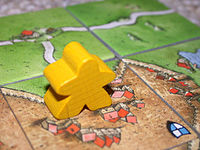
When a tile is placed the player who placed it can choose if he wants to invest a follower somewhere on that tile. If it is placed on a road it will be a thief, on field and it becomes a farmer, in cities they become knights and monks in cloisters. A follower cannot be placed on a feature that is taken by another follower. For example, if a thief is already on that road, a new thief cannot be placed there. But, if a new road is started the player can place a follower there and later those two roads can be connected. If that happens, and both players have the same amount of followers, they share the scores that road gives. Otherwise the player with the most thieves on that road gets all the points.

When a feature is completed, for the road it is when there is either a crossroad or a city on each end, and no more points can be gained there, each follower it returned to the owners hand and score is given. The only followers that cannot return to the owners hand are the farmers, those stay where they are until the game ends.


The Best Sides of Carcassonne

The best thing about Carcassonne is probably that each play through will be different from the last. The players draw tiles and place them wherever they want, following the single rule that each adjacent tile must share the sides feature. The map will be different each time and this keeps the game interesting even if it doesn’t have so many different game mechanics.

Another great thing about Carcassonne is that you can choose how you want to play it, which strategy you want to try this time. For example, you might want to try to control as many farms as possible and try to convince the other players to create lots of small cities for you to score point from. Or maybe you want to try to sabotage as much as possible for the others, trying to lock their followers by placing tiles in such a way that is will be impossible, or at least hard for them, to complete features.

But for me, the absolutely best side of Carcassonne is to try to manipulate where the others place their tiles so that it will benefit me the most, or sabotage for the others.


The Worst Sides of Carcassonne

This one is hard, I really like playing Carcassonne. It might be that the game seems to take longer and longer to play each time the same group plays it. I think this have to do with the fact that you try to figure out where to place the piece in order to achieve the best chance of winning the game, either by scoring the most, sabotage the one that seems to be in the lead, or a combination of both depending on your play style.


Our Experience

Because I had played Carcassonne before we decided that I should pass the first game and let those that had not played it before try it out. We were seven in total but the game only supports five players so two had to wait.

No one seemed to care if they won or not the first game. We helped each other, coming with suggestions where to place the tiles, the different advantages and disadvantages with each spot.

The second game was a bit more competitive. Everyone understood the rules by now. We tried to manipulate the one’s turn it is, trying to make him put the piece where it would not sabotage for us. Explaining why it would be much better for him to put it somewhere else, that he would have a bigger chance scoring a lot of points. Each turn were fairly quick, we did not think all that much before placing the piece. I also think that this was the game that was closest in the amount of points the leads got. I think that it was only a two point’s difference, or something, between the first and third place, with fourth and fifth a bit further back, but not all that much. It was an even game.

The third game took a bit longer to play. The persuasion was increased even more compared to the second game. We tried as much as possible to make him place it somewhere so it would sabotage for someone else. This led to the turns taking longer and longer. The one who’s turn it was wanted to place the tile where it would be most beneficial to him. This led to us thinking over most of the places it could be placed and the advantages and disadvantages with each placement.

We tried to out compete the others farmers and knights. We created a huge city with I think six followers from three different players, when the tiles started to run low we realized that we would probably never be able to finish the city. This meant that the city was only worth half of what it would have been worth if we would have been able to finish it. So, what we learned from that game was that bigger is not always better. Sometimes one has to know when to abandon a project and start over somewhere else. 😉

The fourth game played pretty much as the third, except that I got two of my followers locked up really early in a city I could not finish because there was no tile that fitted in the opening. Someone did not like me that much, I would guess.

So, to summarize our games:

In the first games we tried to help each other out as much as possible. We came with good suggestions and played nice. The turns were fast and the games did not take more than 60 minutes.

The later games were much more about manipulating the others, trying to make them do as you wished while still thinking they did what was best for them. The turns took a lot longer, even though everyone understood the rules a lot better by now and no one had to ask about them. The reason behind this was that we wanted to place the tile at the best possible place; there were a couple of times it took about five minutes to place a single tile and follower. Those games took more than 60 minutes.


Target Audience

I would say that the target audience is those new to board games, those that have little experience in those but want to try them out. I think this because there are few rules so it is a relative easy game to learn and each game takes between 30 and 90 minutes, with most of them finished somewhere between 45 and 60 minutes. No one is ever eliminated in Carcassonne, which means that everyone is still in the game until the end. So no matter how new you are to board games or Carcassonne you will still be able to play for the entire game.

Even though a strategic play is advantageous in Carcassonne, I still think that a younger audience can have great fun playing it even if they can nothing about probability or planning so many turns into the future.


Game Summery

We had a great time playing, from start to finish, during all four games. At least I had it and did not hear anyone complain. Some of them thought it was too much luck involved in what tile was picked and such. I don’t think that was a negative side of the game, it was a strength that in order to score as much points as possible you had to estimate how large chance you had to pick a piece that would allow you to finish a city or road. And then weigh it compared to if it would be worth it to finish the city as soon as possible in order so score points and reclaim your follower, or continue building and increase the scores that follower could bring. There were a lot of tactical decisions to take into consideration before placing a tile and follower. Some of the questions I continuously asked myself whenever I placed a tile and if it would be worth placing a follower too were:

  • Is it a road? They are somewhat easy to complete so I can get it back fairly quickly and not many pieces can hinder a road from being completed. But on the other hand, they are not worth so much per tile as cities.
  • Is it a city? How easy is it to finish it? Have someone else claimed an unfinished city somewhere so I can compete with it? How easy can someone else try to compete with me if I place it here? Can someone get more followers than me here, and how big is that risk?
  • Is it a field? How large chance is it that there will be lots of cities connected to this field? Will someone out compete me here? Is it worth locking a follower for the rest of the game?
  • Is it a cloister? Can this cloister be finished? It is very rarely you will place a cloister and not put a follower in it because it is lots of easy points and not too hard finish the surrounding area.
  • Is it close to the end? Then it is probably worth placing a follower if I got some free, because you can only place one each turn and if you have more followers than it is round left, then you have some followers you will not be able to place.

All in all, I think this game is the most fun when I play with others that think as I do, people who can see what I am up to and tries to ruin my day.

If you have the opportunity, try this great game out. You will not be disappointed 🙂

Standard
Game Design, Programming

Nemesis – Level Generating

So, I have been doing some initial work on my dungeon generation this week. It is not quite as I want it yet, but it is getting there.

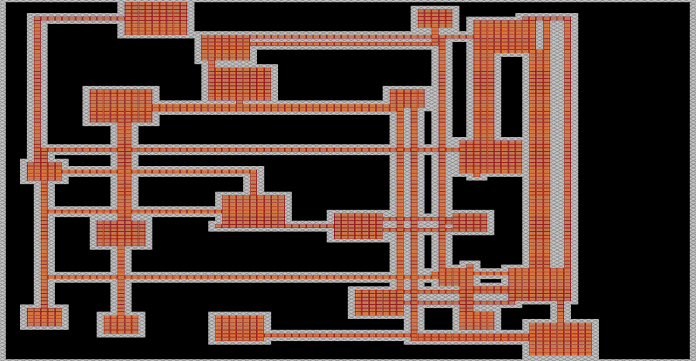
As it is now, it tries to spawning a random number of rooms between 20 and 39. The world is 100 times 100 tiles and each room is between 5×5 and 9×9. Each room gets 10 tries to find a suitable. A suitable spot is somewhere where it will not put any of its floor-tiles on a wall- or floor-tile of another room. When the room is placed its coordinates and size is saved and stuffed into a container where all the rooms are saved.

When all rooms have been spawned it is time to connect them with corridors. I pick the first room and say that it is connected. Then, while there are still rooms not connected, I loop through them and create corridors between them. As it is now it is a very crude way to connect the rooms with corridors, as you see on the image below.

RoomLayout1


What I want to do is to prioritize shorter corridors. By that I mean instead of just picking two random rooms I want to first pick a connected room and then look for one of the three closest to that room that is not connected and make a corridor between them instead. That way the corridors will be shorter and lower the possibility for corridors that are three to four tiles wide.

Next week I will start with the player, making him able to walk and attack. I will also work on creating enemies, for the player to attack.

Standard
Game Design, Programming

Summer Project – Nemesis

It was a long time since I wrote here last time. A bit over 2 month I think it was, but I will try to remedy that during summer. I should be able to do at least one blog update per week.

During the coming 8 weeks I will be working on a new project which I have named Nemesis. The title is not set in stone, so if I come up with a better one, it will probably change.

The game I will make this time is a 2D top-down survival game where you play as a lone survivor after a world war that weakened the barrier between dimensions. You have to survive against the monster onslaught for as long as you can, scavenging resources to upgrade your equipment.

I will write the code in C++ and use the SFML-library for sound, graphics and input.

Standard